Table of Contents
- Why Your Manufacturing Website Isn’t Ranking for Local Keywords
- The Local SEO Ranking Factors That Matter for Manufacturers
- Run a Diagnostic: Is It Your Profile, Your Pages, or Your Site?
- Local Keyword Research for Manufacturers: Intent Beats Volume
- How to Set Up a Google Business Profile for a Manufacturer
- Building Manufacturing Location Pages That Rank and Convert
- Citations, Reviews, Schema and Other Fixes You’re Skipping
- Measuring Local SEO When Your Sales Cycle Runs Six Months
- Frequently Asked Questions
Why Your Manufacturing Website Isn’t Ranking for Local Keywords
A manufacturing website usually fails to rank locally for one of three reasons: an incomplete or miscategorized Google Business Profile, no dedicated pages for the capabilities and areas you serve, or technical problems that keep those pages out of Google’s index.
Local search does not reward the biggest factory. It rewards the clearest signal of where you operate, what you make and who you serve. Most manufacturing sites bury those signals inside a single “Services” page, a stack of PDFs and an address in the footer.
Below is a diagnostic you can run this week, followed by the fixes that move local rankings for industrial firms.
The Local SEO Ranking Factors That Matter for Manufacturers
Local SEO is the practice of making a business visible in location-based search results, including the Google map pack and city-modified searches. Google weighs three factors for local results: proximity, relevance and prominence.
Proximity, relevance and prominence in industrial search
Proximity is the one you cannot control. If a buyer searches from a plant 40 miles away, a shop down the street has the edge for that query.
Relevance and prominence are yours to fix:
- Relevance: Do your site and profile clearly state what you manufacture, which processes you run and which areas you serve?
- Prominence: Do trade associations, industry directories, local business groups and local media mention you?
- Reviews: Do real customers describe working with you, in their own words?
Building dozens of city pages to fake proximity does not work. Relevance is where manufacturers win.
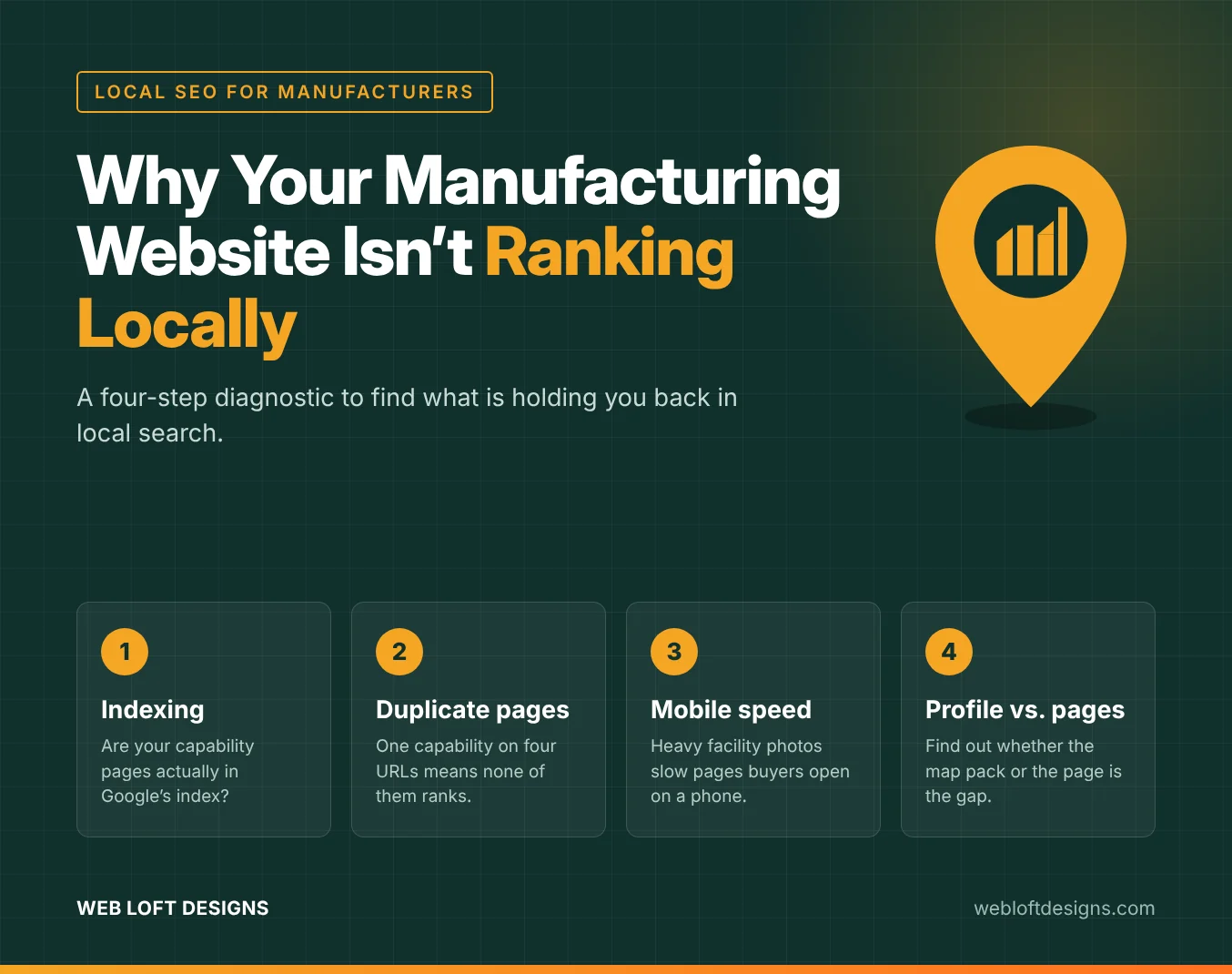
Run a Diagnostic: Is It Your Profile, Your Pages, or Your Site?
Search your core capability plus your city in a private browser window, for example “precision machining Dallas.” Then work through four checks in order. The first one that fails is your first fix.
Step 1: Confirm your pages are indexed, not just live
A page can load perfectly in your browser and still be excluded from Google’s index. Paste the URL into the URL Inspection tool in Google Search Console and read the status. “URL is on Google” means the page is eligible to rank.
On manufacturing sites, the usual causes of exclusion are:
- A noindex tag left over from a staging launch
- A robots.txt rule blocking a folder of capability pages
- A sitemap that was never submitted or is out of date
- Pages reachable only through a filter, a form or a PDF link
A common scenario: a developer blocks the whole site from search engines during a rebuild, and the block is never fully removed at launch.
Step 2: Check for duplicate capability pages
This is the manufacturing-specific problem generic local SEO guides skip. A shop with 14 capabilities often describes the same CNC turning work on a “Services” page, a “Capabilities” page, a “Products” page and three PDFs, each in slightly different words.
Search your site for your core capability terms. If one capability appears on four URLs, those pages compete with each other and none of them ranks well. Pick one page per capability, merge the rest into it and redirect the old URLs.
Step 3: Test speed and usability on mobile
Industrial buyers often check suppliers from a phone between meetings or on the shop floor. Open your key pages on a phone over a cellular connection, not office Wi-Fi.
Check three things:
- Page speed: Run the page through PageSpeed Insights and look at the mobile score, not the desktop score.
- Image weight: Facility and equipment photos are the usual culprit. One uncompressed phone photo can outweigh the rest of the page.
- Render-blocking scripts: Chat widgets, tracking pixels and sliders stacked together delay the first screen.
Step 4: Separate the profile problem from the page problem
If your profile shows in the map pack but your pages do not rank in the regular results, the problem is on the pages: thin content, missing location signals or duplicates. If neither shows, the problem is more likely the profile: the wrong primary category, an unverified listing or a service area that does not match where buyers search.
Tip: Write down which step failed before you change anything. Fixing the one broken layer is usually faster than rewriting the whole site.
Local Keyword Research for Manufacturers: Intent Beats Volume
High-volume keywords mislead industrial marketers. “CNC machining” has national volume and very little buying intent from your region. “Precision machining Dallas” or “metal fabrication Fort Worth” has far less volume and far more intent.
Build your list in three buckets:
- Capability + location: “injection molding Houston”
- Capability + modifier: “5-axis machining shop near me”
- Problem queries: “who makes custom hydraulic fittings”
Check difficulty and competition before committing. A phrase with modest volume and clear buying intent beats a broad term every time, and it tells you exactly which page should exist to answer it.
How to Set Up a Google Business Profile for a Manufacturer
A Google Business Profile is the most influential local asset a manufacturer owns, and the one most often left half-finished. Claim and verify it, then fill it out like a spec sheet, not a brochure.
Categories, attributes and service areas that fit industrial buyers
- Primary category: choose the closest match to what you actually do, such as “Machine shop,” “Metal fabricator” or “Manufacturer”
- Secondary categories: add the two or three that fit your real output, not every loosely related option
- Service areas: list the metros and counties you genuinely serve
- Products and services: add your core capabilities with short, specific descriptions
- Photos: upload real images of the facility, equipment and finished parts
Keep the business name, address and phone number identical to your website. Post updates monthly, answer questions in the Q&A section and respond to every review.
Building Manufacturing Location Pages That Rank and Convert
Manufacturing location pages are dedicated pages that pair your capabilities with a specific facility or service area. They rank because they answer a specific search completely.
The hard part is not the template. It is deciding which pages should exist. A manufacturer with one plant and no showroom cannot copy the playbook a dentist uses for five neighborhood offices.
Match the page structure to your facility footprint
One facility, regional service area. You run a single plant but ship or install across several states. Build one strong page for your home metro, plus regional pages only for markets where you have real customers, installs or sales coverage. Every other area belongs in a “Service Areas” section on the main page.
Multiple plants. Give each plant its own page naming the facility, the capabilities housed there, the equipment list and the service radius. Link all plant pages from one locations hub so Google can see how they relate.
No customer-facing storefront. This is the most common manufacturing case. You are not competing for walk-in “near me” traffic, so set your Google Business Profile as a service-area business if visitors don’t come on site, and focus your pages on capability-plus-region searches that procurement teams actually use.
What every location page needs to include
- An H1 naming the capability and the area
- The capabilities and equipment available at that facility
- Industries served and typical lead times
- Certifications, such as ISO 9001 or AS9100, where they apply
- A map and your exact name, address and phone number
- Proof: facility photos and project examples
- A clear request-for-quote path
Avoid the doorway-page trap
The fastest way to get filtered out of local results is to publish dozens of city pages from one template with only the city name swapped.
Use this test: could a buyer learn something from this page that they could not learn from the page for the next city over? If two pages share most of their text, merge them.
Key takeaway: One strong location page that generates quote requests beats ten thin pages that rank for nothing. Judge pages by qualified inquiries, not impressions.
Citations, Reviews, Schema and Other Fixes You’re Skipping
NAP consistency means your business name, address and phone number match exactly everywhere they appear online. One “St.” versus “Street” mismatch is minor. Five variations across 30 directories weaken the signal Google uses to trust your location.
Work through these in order:
- Audit your top 20 directory listings for exact name, address and phone matches
- Claim trade association, industry directory and chamber of commerce profiles
- Ask satisfied customers for Google reviews that mention the work and the location
- Earn local mentions through supplier partnerships, sponsorships and regional trade press
- Add LocalBusiness or Organization schema with your address, service area and contact details
- Compress images and recheck mobile load speed
- Confirm every location page is indexed and linked from your main navigation or locations hub
Indexing and crawl problems quietly cancel out everything else on this list. Fix them before you write another word of content.
Measuring Local SEO When Your Sales Cycle Runs Six Months
Rank tracking alone will mislead you. A manufacturing buyer may research for months before calling, and that gap hides real progress.
Track these instead:
| Metric | What It Tells You | Check Frequency |
|---|---|---|
| Map pack position for core queries | Visibility where local buyers look first | Weekly |
| Location page organic traffic | Whether the pages are being found | Monthly |
| Qualified form submissions by page | Which pages produce real leads | Monthly |
| Calls and direction requests from your profile | Profile-driven contact volume | Monthly |
| Review count and rating | Growth in trust signals | Monthly |
Tip: Tag contact and quote forms by source page. When a large account closes months later, you can trace it back to the page that earned the first inquiry.
Local SEO for manufacturers is not a quick win. It is a compounding asset: build the profile, publish real location pages, fix the technical basics and measure leads rather than rankings.
Get Your Manufacturing Website Found Locally
Most manufacturing sites do not fail because of one dramatic error. They fail because no one connected the profile, the pages and the tracking into one system. Web Loft Designs has been building websites since 2003, and our SEO packages cover the technical fixes, location pages and local signals described above. See how we approach this work in our case studies, or talk to our team about your website.
Frequently Asked Questions
Why is my manufacturing website not showing up in local search results?
Usually it comes down to an incomplete or miscategorized Google Business Profile, no dedicated pages for your capabilities and service areas, or inconsistent business information across directories. Google ranks local results on proximity, relevance and prominence. Start by checking that your pages are indexed and that your name, address and phone number match everywhere.
How do manufacturers rank for local keywords?
Manufacturers rank locally by pairing a complete Google Business Profile with pages that target real buyer searches, such as a capability plus a city or region. Reviews, directory citations, local links and clean technical SEO all support those pages. Treat each location page as the answer to a specific buyer question, not a template with the city swapped out.
Does a manufacturing company need a separate page for each service area?
Only for areas where you have real customers, a facility or sales coverage. Each page needs unique content: the capabilities available, equipment, lead times, industries served and a clear way to request a quote. If a location only warrants a paragraph, list it in a broader service-area section instead of creating a near-empty page.
How long does it take to improve local search rankings?
Google Business Profile changes can show up within a few weeks. Location pages and citation cleanup typically take two to four months to move local rankings, and competitive industrial markets take longer. Track impressions, calls and form submissions alongside rankings, since one qualified B2B lead can be worth more than dozens of clicks.