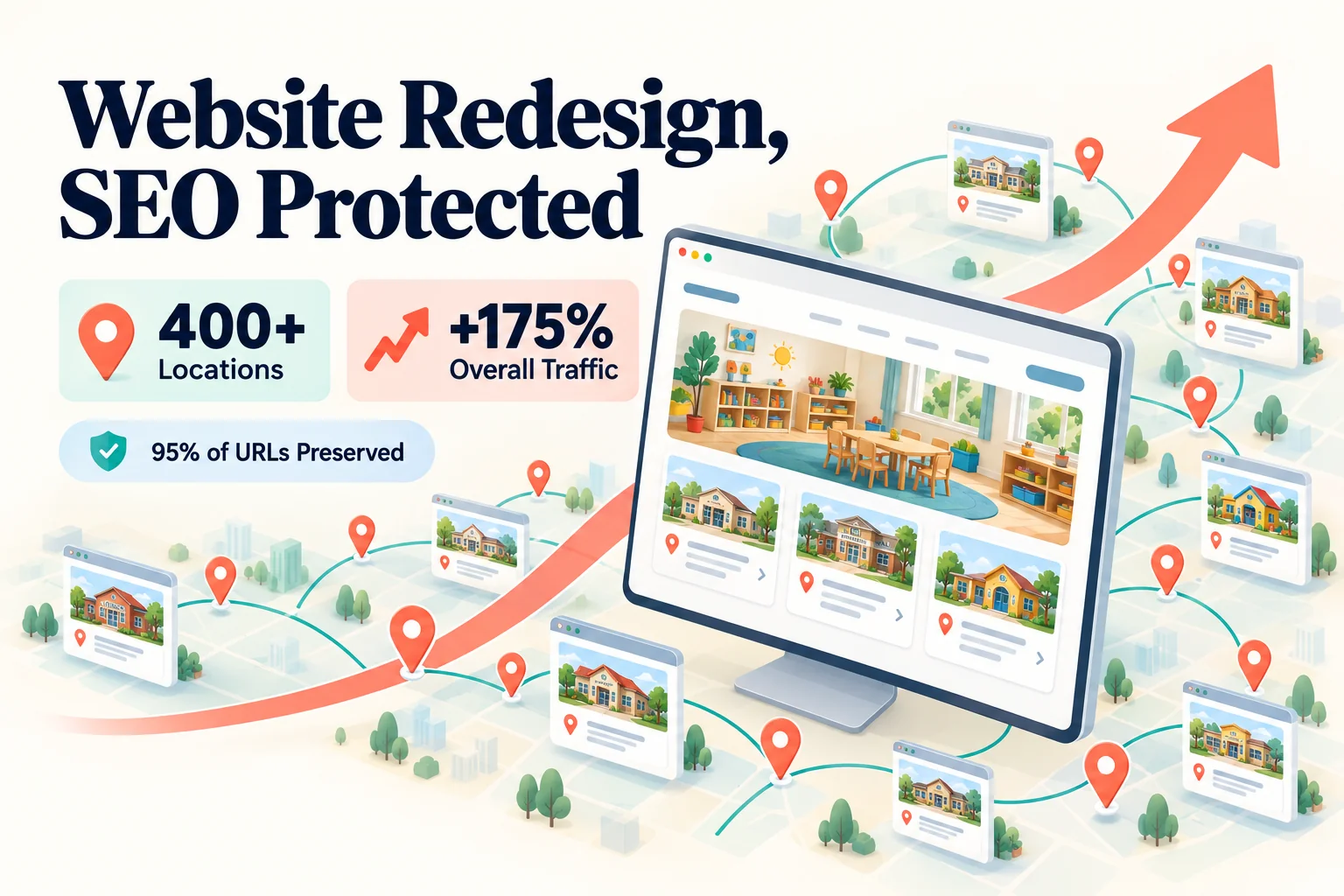
A website redesign is one of the riskiest moments in a brand’s search life. New templates, new navigation and new URLs can wipe out years of organic visibility in a few weeks if the move isn’t planned carefully. When The Learning Experience asked us to rebuild a website serving more than 400 locations, protecting search traffic was just as important as the new design.
The short answer: You can redesign a large website without losing SEO if you keep as many existing URLs as possible, redirect the rest one-to-one, and treat the launch as the start of a monitoring period, not the finish line. For The Learning Experience, that approach kept organic traffic stable through launch, turned it into year-over-year growth within four weeks, and led to a 175% increase in overall traffic.
The Results at a Glance
|
Metric |
Result |
|---|---|
|
URLs preserved during the migration |
95% |
|
Organic traffic change two weeks after launch |
-6% (temporary dip) |
|
Organic traffic four weeks after launch |
+23% year over year |
|
Overall traffic growth |
+175% |
|
Conversions (Jan 1 to Oct 16, 2024 vs. same period in 2023) |
+97.52% |
|
Tracked events (same period) |
+314.82% |
|
Phone calls (same period) |
+42.57% |
The Client: A National Early Education Brand With 400+ Locations
The Learning Experience (TLE) is an early education and child care company based in Deerfield Beach, Florida, with more than 400 locations across the country. TLE approached Web Loft Designs in the fall of 2022.
Their website had to work for two very different audiences at the same time:
- Parents comparing child care options, often making quick, last-minute decisions about where to enroll.
- Job seekers looking for teaching roles, which mattered a great deal because staffing was one of TLE’s biggest business concerns.
TLE also wanted the site to position the brand as a growth-focused preschool, not just a traditional daycare.
The Challenge: Fix Performance, Visibility and Experience Without Breaking Search
The existing website had three connected problems:
- Site performance issues that hurt both user experience and search performance.
- Poor organic visibility for a brand of TLE’s size and reach.
- A disjointed customer experience that made it harder for parents to inquire and for candidates to apply.
A full redesign was the right fix for all three. But with hundreds of location pages and years of indexed content, the redesign also carried real SEO risk. Large site migrations commonly cause temporary drops in organic traffic, and badly handled ones can take months to recover. The goal was to get the benefits of a new site without paying that price.
What We Did
1. Started With Comprehensive Audits
Before any design work began, we audited the existing site to understand what was already performing, where users were dropping off, and what was holding back conversions. That audit shaped a four-month strategy covering user journeys, conversion paths and form submissions.
2. Planned a Soft Migration
Instead of rebuilding the URL structure from scratch, we ran a soft migration that preserved 95% of the existing URLs. Pages that already had rankings, backlinks and history in search kept their addresses, so search engines had very little to reprocess. The small share of URLs that did change was redirected to their closest equivalents.
This is the single biggest lever in protecting SEO during a redesign. Every URL that stays the same is a page that keeps its search equity by default.
3. Built Location Microsites at Scale
We designed and developed custom microsites for more than 400 locations, each with API-integrated lead forms. That gave every center its own landing page for local searches while sending inquiries directly into TLE’s systems.
4. Made Careers a Core Part of the Site
To support TLE’s hiring goals, we built dedicated sections highlighting teaching opportunities and career benefits, and integrated the site with TLE’s job boards, Greenhouse and CareerPlug. Candidates could move from learning about a role to applying without leaving the experience.
5. Added Trust Signals and Content
We integrated Google Business Profile reviews into the site, published 60 blog posts, and implemented accessibility improvements across the new build. Together, these gave parents more reasons to trust TLE and gave search engines more relevant content to rank.
6. Launched on Schedule
Work moved from planning through design and development starting in April 2023, and the new site launched in October 2023.
The Results
Two weeks after launch, organic traffic was down just 6%, a small, temporary dip for a migration of this size. By week four, organic traffic was up 23% year over year. In the quarter covered by the case study, overall traffic grew 175%.
The gains went beyond traffic. Comparing January 1 to October 16, 2024 with the same period in 2023:
- Conversions increased 97.52%.
- Tracked events increased 314.82%.
- Phone calls increased 42.57%.
The new careers sections attracted more qualified job applicants, which helped address TLE’s staffing challenges. And the clearer message about what makes TLE different led to more inquiries from parents actively looking for child care.
Lessons for Your Own Website Redesign
Every site is different, but the TLE project highlights a few principles that apply to almost any redesign:
- Keep URLs whenever you can. A new design does not require new URLs. The fewer addresses that change, the less ranking history is at risk.
- Redirect one-to-one, not to the homepage. When a URL has to change, point it to the closest matching new page so its relevance carries over.
- Audit before you design. Know which pages drive traffic and conversions so the new site protects them.
- Treat launch as the start of monitoring. Watch organic traffic, indexing and conversions closely for the first few weeks. A small early dip is normal; a steep or lasting one is a signal to act.
- Design for every audience the site serves. TLE’s results came from serving parents and job seekers equally well, not from SEO alone.
Frequently Asked Questions
Will a website redesign hurt my SEO?
It can, but it doesn’t have to. Most SEO losses during a redesign come from changed URLs without proper redirects, removed content and technical issues introduced at launch. Preserving URLs, redirecting carefully and monitoring after launch keeps the risk low. In TLE’s case, organic traffic dipped only 6% after two weeks and was up 23% year over year by week four.
How long does it take for traffic to recover after a site migration?
It depends on the size of the site and how the migration is handled. A well-planned migration may see only a short, shallow dip. TLE’s organic traffic moved from a 6% dip to year-over-year growth within four weeks of launch.
What is a soft migration?
A soft migration is a redesign or platform change that keeps most of the existing URL structure in place. Because search engines see the same addresses, pages keep their rankings and history, and only the small number of changed URLs needs redirects.
Can a redesign improve conversions as well as traffic?
Yes. A redesign is a chance to fix user journeys, forms and messaging at the same time. For TLE, conversions rose 97.52% and phone calls rose 42.57% year over year after the new site launched.
Planning a Redesign?
If you’re planning a new website and want to protect the search traffic you’ve already earned, we can help you plan the move before a single page changes. Read the full The Learning Experience case study, explore our website design and development services, or get a free quote to talk through your project.