Your business is growing, but where is the money going? Sales are up, the calendar is full, and you are bringing on more clients than ever. Yet when you look at the bank account, it does not feel like a business that is growing. Some months it feels tighter than it did a year ago.
This is one of the most common frustrations we hear from small business owners, and it usually comes down to one thing: revenue, profit, and cash flow are three different numbers. A business can be strong on one and struggling on another. In this post, we break down the difference, show where the money in a growing business usually goes, and explain when it makes sense to bring in help. We also asked Allison Caddy, founder of Ready Set Streamline, a QuickBooks Online bookkeeping business for established U.S.-based service businesses, to share what she sees with her clients every day.
Revenue vs. Profit vs. Cash Flow: What Is the Difference?
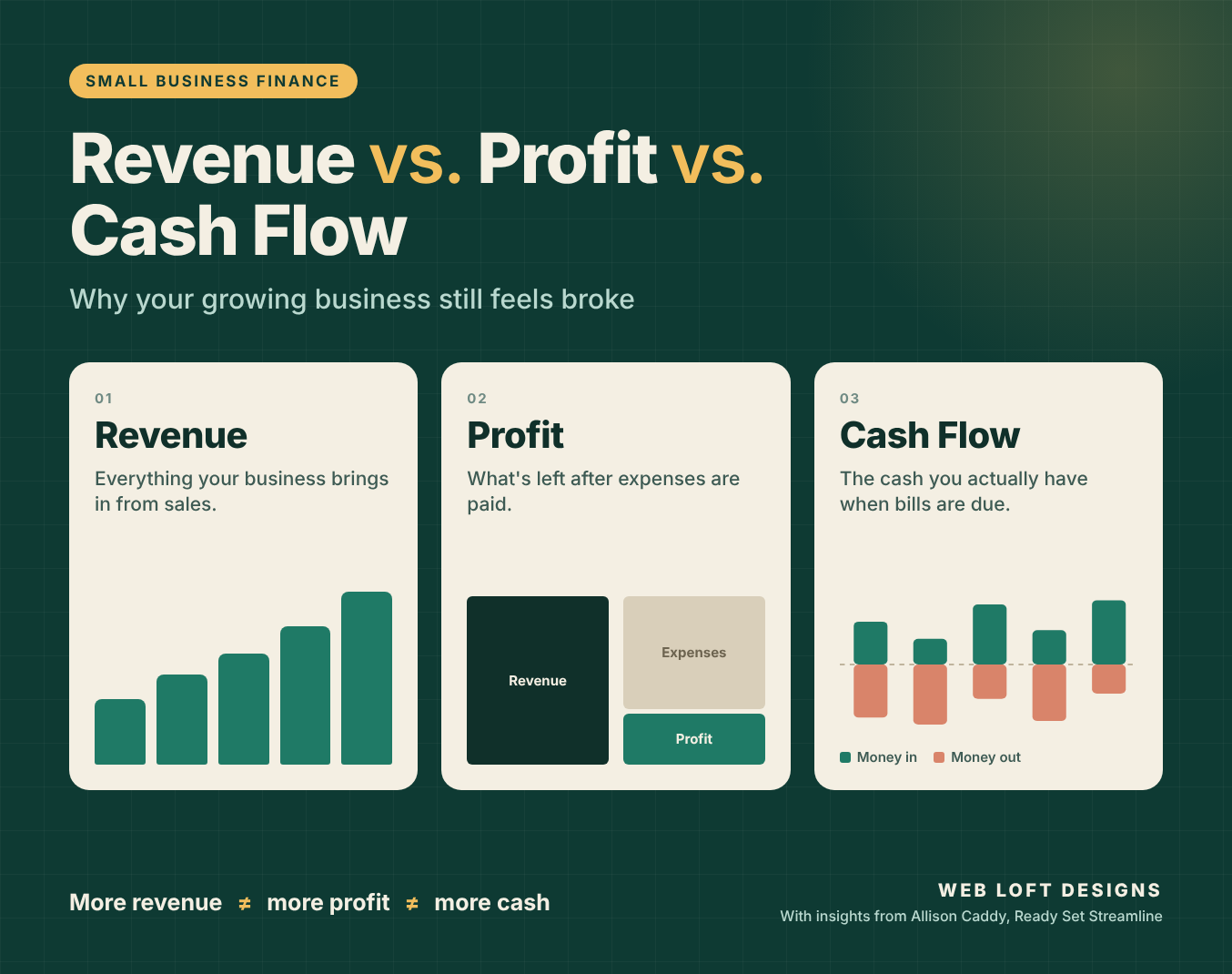
Here is the short version:
- Revenue is the total money your business brings in from sales before any expenses.
- Profit is what is left after your business expenses are subtracted from revenue.
- Cash flow is the movement of money into and out of your business over a period of time.
Allison explains it this way:
“Revenue is the money the business brings in. Profit is what remains after business expenses are subtracted. Cash flow is the movement of money in and out of the business, so a business can be profitable on paper and still feel short on cash if timing, spending, owner withdrawals, taxes, or other obligations are not being managed carefully.”
Allison Caddy, Founder, Ready Set Streamline
| Number | What it measures | The question it answers |
|---|---|---|
| Revenue | Total sales brought in | How much are we selling? |
| Profit | Revenue minus expenses | Are we actually making money? |
| Cash flow | Money moving in and out over time | Do we have the cash to cover what is due? |
Why More Revenue Does Not Automatically Mean More Profit
Growth almost always comes with new costs. To serve more clients, businesses hire more people, add software, spend more on advertising, and take on bigger projects that require more upfront work. If those costs grow faster than revenue, profit shrinks even while sales climb.
Timing makes it harder. You may pay staff, contractors, and vendors this month for work your clients will not pay for until next month or later. On paper, the business is doing well. In the bank account, the money has not arrived yet. And as revenue grows, so does the tax bill, which can catch owners off guard if they have not planned for it.
Warning Signs Your Growing Business Has a Cash Flow Problem
According to Allison, one of the biggest warning signs is when revenue keeps increasing but the owner still feels unsure about how much cash is actually available. Other signs she sees include:
- Regularly moving money between accounts to cover bills
- Being surprised by tax bills
- Not knowing what you can safely pay yourself
- Seeing strong sales without a clear increase in profit
If two or more of these sound familiar, the problem is usually not a lack of sales. It is a lack of visibility into where the money is going.
Where the Money in a Growing Business Usually Goes
Customer acquisition and marketing costs
Getting new customers costs money: ads, promotions, sales tools, agency fees, and the time your team spends on outreach. Those costs are easy to approve one by one and hard to see as a whole. Without tracking, a business can spend more and more to win each new customer without noticing that margins are shrinking.
A website that gets traffic but does not convert
Many businesses pay for traffic through ads, SEO, and social media, then send visitors to a website that does not turn them into leads. Slow pages, unclear service pages, weak calls to action, and contact forms that are hard to find or broken all quietly waste the marketing budget. The traffic report looks fine, but the phone does not ring. A website built around conversions fixes the leak before more money goes into traffic.
Spending nobody tracks
Software subscriptions, duplicate tools, auto-renewing services, and small recurring charges add up. In a growing business, new expenses get added faster than old ones get reviewed.
Taxes that were not set aside
Allison recommends that owners think about money set aside for taxes as money that is already committed, not extra cash available to spend:
“The exact amount to set aside depends on the business structure, income, and tax situation, so that percentage should be determined with a tax professional. From a cash-management standpoint, the important part is regularly moving that money aside instead of waiting until a tax payment is due.”
Allison Caddy
The Biggest Mistake: Managing the Business by Bank Balance
When we asked Allison about the most common mistake she sees growing service businesses make with their numbers, her answer was clear: relying too heavily on the bank balance instead of accurate, up-to-date financial reports.
“The bank balance only shows what is in the account today. It does not tell you how profitable the business is, which expenses are increasing, what money needs to be reserved for taxes, or whether current spending is sustainable.”
Allison Caddy
A healthy-looking balance can hide a tax bill that is coming due, a client invoice that has not been paid, or expenses that are quietly growing every month.
How to Know If Your Marketing and Website Spend Is Paying Off
Marketing is often one of the largest expenses in a growing business, and one of the least measured. Allison’s advice is to track marketing and website spending separately enough that you can compare it with the results that spending is generating, such as leads, booked calls, new clients, or revenue tied to a specific channel.
“The goal is not just to ask whether marketing is producing activity, but whether the revenue and profit generated justify the cost over time.”
Allison Caddy
On the website side, that starts with being able to see what your site is actually producing:
- Track conversions, not just traffic. Form submissions, phone calls, booked consultations, and purchases should all be tracked as conversions in your analytics.
- Know where leads come from. Tag your campaigns and review leads by source so you can see which channels bring in paying clients, not just visitors.
- Give every service a clear page. A focused service page with a clear call to action converts better than a general page that tries to cover everything.
- Fix what leaks. Slow load times, broken forms, and confusing navigation cost you leads you already paid to attract.
When marketing results and financial reports are both accurate, you can make decisions based on what actually brings in profitable work, not on what simply feels busy.
When Should a Business Hire a Bookkeeper?
According to Allison, a business should consider bringing in a bookkeeper when:
- Keeping the books current is becoming inconsistent
- Financial reports are not reliable, or there are none
- The owner is spending too much time trying to manage the accounting themselves
Once the books are accurate and current, she says the biggest change is visibility. Owners can see where revenue is coming from, where money is going, and how profitable the business is, and they can make decisions using actual numbers instead of estimates.
Allison shared an example that will feel familiar to many of our readers. She recently worked with a web designer who needed about five years of bookkeeping caught up. The designer had been running the business without a clear picture of her expenses, overall profitability, or what her numbers were really telling her. After Allison brought the books up to date, categorized and reconciled the historical activity, and provided accurate financial reports, the designer could finally see where the money had gone and how the business had performed, and she used those records to get caught up on her taxes.

“The biggest change was that she went from guessing based on her bank balance to having reliable financial information she could understand and use to make informed decisions going forward.”
Allison Caddy
Grow With Clearer Numbers and a Website That Pulls Its Weight
Growth should feel like progress, not pressure. If your business is growing but the money is not following, start with two questions: Do you have accurate, up-to-date numbers? And is your website and marketing spend actually bringing in profitable work?
For your books: Allison Caddy is the founder of Ready Set Streamline, a QuickBooks Online bookkeeping business for established U.S.-based service businesses. She helps business owners get accurate, up-to-date books, understand where their money is going, and get clearer visibility into cash flow, owner pay, profitability, and how much to set aside for taxes so they can make better-informed financial decisions.
For your website and marketing: Web Loft Designs helps small businesses and startups build websites that generate leads, with SEO, conversion tracking, and digital marketing that shows you exactly what your spend is producing. If your site gets traffic but not enough calls or inquiries, let’s talk.
Frequently Asked Questions
Can a business be profitable but have no cash?
Yes. A business can show a profit on paper and still be short on cash when client payments arrive later than bills are due, when the owner withdraws money, when taxes come due, or when cash goes into inventory, equipment, or debt payments. Profit measures whether the business makes money over a period; cash flow measures whether the money is available when you need it.
What is the difference between revenue and profit?
Revenue is the total money a business brings in from sales. Profit is what remains after all business expenses are subtracted from that revenue. A business can increase revenue while profit stays flat or falls if expenses grow faster than sales.
How much should a small business set aside for taxes?
The right amount depends on your business structure, income, and tax situation, so the percentage should be set with a tax professional. What matters most for cash flow is moving that money aside regularly, as revenue comes in, rather than waiting until a payment is due.
When should a small business hire a bookkeeper?
Consider hiring a bookkeeper when your books are no longer kept up consistently, your financial reports are not reliable, or you are spending too much of your own time on accounting. Accurate books give you a clear view of revenue, expenses, and profitability so you can make decisions based on real numbers.
How do I know if my marketing is profitable?
Track your marketing and website spending separately by channel, then compare it with the results each channel produces, such as leads, booked calls, new clients, and revenue. Over time, the revenue and profit a channel generates should justify what you spend on it.