


Table of Contents
- What Drives Custom Web Application Development Pricing
- Design, Integrations, and the Features That Move the Number
- Hourly Rate vs. Total Development Cost
- How Long Does Custom Web Application Development Take?
- How to Control Web Application Development Costs Before Development Begins
- MVP vs. Enterprise Platform: Matching Scope to Budget
- Web Application Maintenance Costs After Launch
- The Real Cost of Cutting Corners
- Conclusion
- Frequently Asked Questions
Last Updated: September 18, 2026
What Drives Custom Web Application Development Pricing
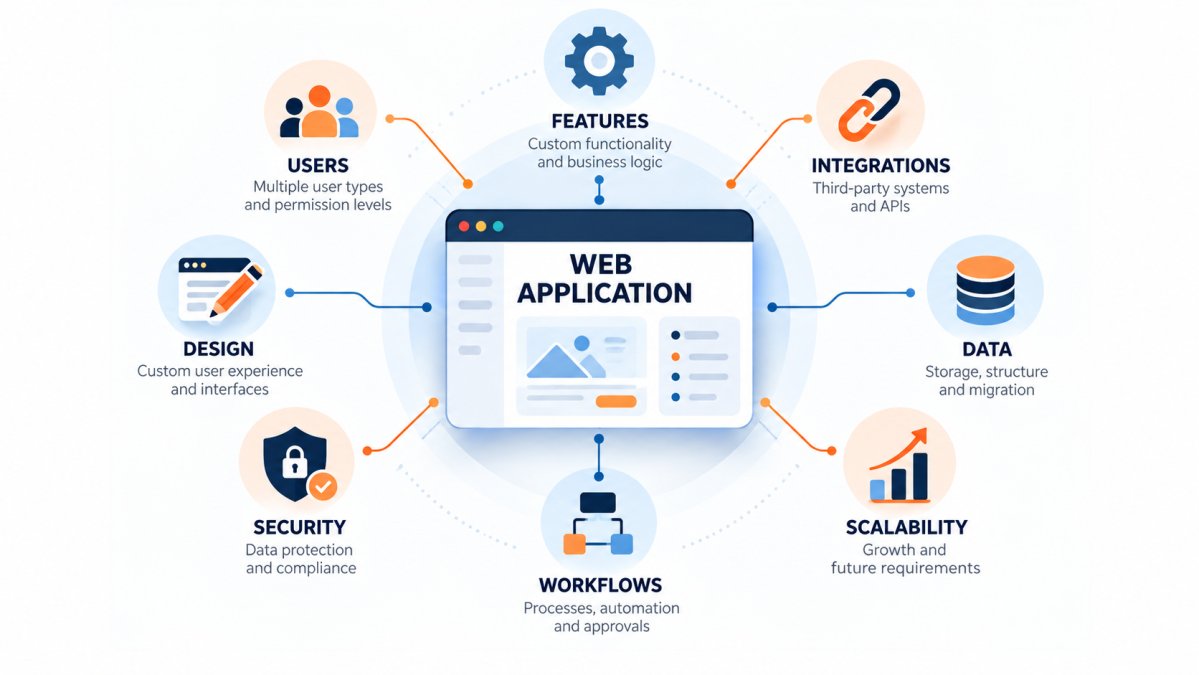
Custom web application development pricing can vary dramatically because no two applications have exactly the same requirements. A focused application with a limited feature set may cost tens of thousands of dollars, while a complex platform involving multiple user types, custom workflows, third-party integrations, large amounts of data, advanced security requirements, or ongoing development can reach six figures.
At Web Loft Designs, we have been building custom websites and web applications since 2003, and one thing we have learned is that a feature list alone rarely tells you what a project will cost. The real cost depends on what the application needs to accomplish, who will use it, how the users move through it, what systems it needs to connect with, and how much complexity exists behind the interface.
This guide explains the factors that actually affect web application pricing and how to budget intelligently before development begins.
Complexity Tiers and What They Mean for Your Budget
Complexity is one of the biggest factors affecting development cost, but assigning a reliable price based on labels such as “simple,” “medium,” or “complex” can be misleading. Two applications that look similar on the surface can require very different amounts of work behind the scenes.
Instead of starting with an industry-average price, we recommend evaluating the application based on the factors that actually determine the scope:
|
Cost Driver |
Lower Complexity |
Higher Complexity |
|---|---|---|
|
Users |
One or limited user types |
Multiple roles and permission levels |
|
Workflows |
Straightforward processes |
Complex rules and automation |
|
Integrations |
Few or standard integrations |
Multiple/custom/legacy systems |
|
Data |
Limited/simple data |
Large, complex or migrated datasets |
|
UX/UI |
Standard interactions |
Custom interfaces and workflows |
|
Security |
Standard requirements |
Sensitive data or advanced compliance |
|
Scalability |
Limited initial usage |
High-volume or rapid-growth requirements |
Design, Integrations, and the Features That Move the Number
Design, integrations, business logic, and custom workflows can significantly affect the cost of a web application.
Integrations are particularly easy to underestimate. What sounds like “connect the application to our CRM” may involve authentication, data mapping, custom API work, error handling, testing, security requirements, and ongoing maintenance.
That’s why integrations should be identified during discovery—not after development has already started. The same applies to custom workflows. Before estimating a project, the development team should understand what happens when a user takes an action, where the data goes, what other systems are involved, and what needs to happen next.
Hourly Rate vs. Total Development Cost
Hourly rates vary considerably between development companies, freelancers, geographic regions, and specialties, but hourly rate alone is a poor way to compare development costs.
A lower hourly rate does not necessarily produce a less expensive project. Experience, architecture decisions, development efficiency, communication, project management, testing, and the amount of rework required can have a much greater impact on the final cost.
When comparing development partners, look beyond the hourly rate. Ask how the project will be scoped, who will manage it, how changes are handled, what testing is included, how progress is communicated, and what happens after launch.
How Long Does Custom Web Application Development Take?
There is no standard timeline for custom web application development. A focused application may be completed relatively quickly, while a large platform with multiple integrations, user roles, workflows, data requirements, or compliance considerations can take considerably longer.
The timeline is usually influenced by five major phases: discovery and planning, UX/UI design, development, testing and quality assurance, and deployment.
Client communication also matters. Delays in content, approvals, requirements, access to third-party systems, or feedback can significantly affect the schedule. A well-defined scope and timely decision-making are often just as important to the timeline as the development itself.

Project planning helps define development phases, dependencies, responsibilities, and realistic timelines before development begins.
|
Phase |
Share of Budget |
What Happens |
|---|---|---|
|
Discovery |
10-15% |
Scope, architecture, requirements |
|
Design |
15-20% |
UI/UX, prototyping |
|
Development |
40-50% |
Frontend, backend, APIs |
|
Testing |
15-20% |
QA, security, performance |
|
Deployment |
5-10% |
Launch, monitoring setup |
How to Control Web Application Development Costs Before Development Begins
One of the best ways to control development costs is to make important decisions before significant development begins. In our experience, projects become unnecessarily expensive when requirements continue to change after architecture and development are already underway.
Start by defining the business problem the application needs to solve—not simply creating a long feature list. Then:
- – Separate must-have functionality from nice-to-have features.
– Identify the different types of users and what each one needs to accomplish.
– Map the primary user journeys and workflows.
– Identify third-party integrations early.
– Determine what can use existing technology and what genuinely requires custom development.
– Consider launching an MVP first when appropriate.
– Plan for future growth without overengineering the first version.Good discovery doesn’t make a project more expensive. Done correctly, it helps prevent expensive changes, unnecessary development, and rework later.
MVP vs. Enterprise Platform: Matching Scope to Budget
An MVP, or minimum viable product, is designed to validate the core concept with the smallest set of functionality necessary to make the application useful. For many businesses, this can be a smarter starting point than trying to build every planned feature in version one.
An enterprise platform is different. It may require multiple user roles, advanced permissions, complex integrations, large datasets, sophisticated workflows, higher security requirements, and infrastructure designed for scale.
The goal should not be to build the cheapest possible version or the biggest possible version. It should be to build the right first version, validate it, learn from actual users, and expand strategically.
Web Application Maintenance Costs After Launch
Most guides quote an annual maintenance figure and move on. That number is only one line in a larger total cost of ownership (TCO) picture, and the lines most teams miss are the ones that grow fastest. TCO over three years often exceeds the initial build, and the reason is that several cost streams scale independently of how many users you have.
The Four Cost Streams After Launch
1. Ongoing maintenance and support. Platform updates, dependency patches, bug fixes, and small enhancements. The actual figure for ongoing maintenance and support depends on how much the application changes and how many third parties it depends on.
2. Cloud infrastructure. Hosting, databases, storage, bandwidth, and compute. This stream scales with usage, not with your budget. A build that is efficient at 500 users can become expensive at 50,000 if the architecture was not designed for that growth. Infrastructure cost is a function of architecture, not of the invoice you signed at launch. Optimizing these underlying resources often requires a transition toward managed cloud hosting to ensure that performance remains consistent as your user base expands.
3. Third-party licenses and API fees. Payment processing, mapping, messaging, authentication, analytics, and any commercial API the application depends on. These are usually billed per transaction, per seat, or per call, so they rise with success. They are also the line most likely to be omitted from a build estimate entirely.
4. Security and compliance. Vulnerability scanning, penetration testing, dependency auditing, and any regulatory obligations that apply to your data. Compliance is not a one-time project. It is a recurring cost that grows as the application handles more sensitive data or serves more regulated users.
How Architecture Choices Set Your Future Scaling Bill
This is the part competitors skip. The architecture you choose at build time determines what scaling costs you later, and the difference is not small.
A single unified codebase is simpler and cheaper to build and run at low volume.
A Three-Year TCO Worksheet
|
Cost stream |
Year 1 |
Year 2 |
Year 3 |
What drives it |
|---|---|---|---|---|
|
Maintenance and support |
Highest (stabilization) |
Steady |
Steady |
Change volume, dependency count |
|
Cloud infrastructure |
Low |
Rising |
Rising faster |
Users, data volume, architecture |
|
Licenses and API fees |
Low |
Rising with usage |
Rising with usage |
Transactions, seats, API calls |
|
Security and compliance |
Baseline |
Baseline plus audits |
Baseline plus audits |
Data sensitivity, regulations |
The Real Cost of Cutting Corners
Reducing scope and cutting corners are not the same thing.
Reducing scope can be smart: launch with fewer carefully selected features, validate them, and expand later. Cutting discovery, testing, security, documentation, or architectural planning simply moves cost and risk further down the road.
A successful application should not only work on launch day. It should be maintainable, scalable, secure, and practical for the business to operate after launch.
Conclusion
There is no single price for custom web application development because there is no single type of web application.
The most reliable way to establish a realistic budget is to start with the business problem, define the users and their journeys, identify the required functionality and integrations, and determine what truly needs to be included in the first release.
At Web Loft Designs, we’ve been building custom websites and web applications since 2003. One of the most important lessons we’ve learned is that successful development isn’t about building the largest feature list. It’s about building the right solution for the business, making smart decisions about where to invest, and creating technology that can continue to evolve after launch.
Frequently Asked Questions
How much does custom web application development cost in 2026?
The cost of custom web application development varies widely depending on complexity and scope. Simple applications are less costly than medium complexity projects, and enterprise platforms represent a higher investment. A scoped MVP is typically a lower-cost starting point.
What factors influence the total price of a custom web application?
The biggest cost drivers are feature complexity, UI/UX design, backend architecture, API integrations, and security compliance requirements. Custom UI/UX design is a significant factor in the cost. Project scope, technology stack, and whether you choose fixed-price or time and materials contracts also shift the final number. In practice, every feature you add after discovery compounds both build time and testing effort.
How do hourly rates compare to fixed-price contracts for web development?
Hourly rates vary by region, with different ranges in the United States, Western Europe, and Eastern Europe. Fixed-price contracts cap your exposure but usually bake in a risk buffer, so you pay more upfront for certainty. Time and materials contracts often cost less if scope stays tight, but they expose you to overruns. Ask for a detailed scope document either way.
What is the typical timeline for custom web application development?
The timeline for custom web application development varies. Small business applications often finish in 4 to 6 months, while mid-complexity builds take longer. Discovery, design, development, testing, and deployment each consume a phase. Agile methodology shortens feedback loops but does not shrink the total calendar much unless you cut scope.
What hidden costs should I account for in web application development?
Post-launch maintenance and updates are an ongoing cost, excluding third-party licenses and subscriptions. Budget also for cloud infrastructure scaling, security patches, and feature iterations after real users hit the product. Technical debt from rushed builds often surfaces as expensive rework within the first year. Plan for total cost of ownership, not just the initial build.
How does complexity impact the final cost of a web application?
Complexity drives cost more than any other variable. Simple apps with standard interfaces are less costly than medium complexity projects, and enterprise platforms represent a higher investment. Each added integration, custom workflow, or compliance requirement multiplies testing and quality assurance hours.