


Quick Summary
A web development RFP starts with your business goals and success metrics, then defines the scope of work and technical requirements in detail. A clear RFP keeps vendors from guessing at your needs and gives you a fair way to compare proposals side by side.
- Set 3 to 5 measurable goals, such as increasing qualified leads by 15% or cutting page load time to under 2 seconds.
- List functional and design requirements separately: what the site must do, and which constraints are non-negotiable.
- Define what is out of scope and how change requests will be handled, so the project does not grow after the contract is signed.
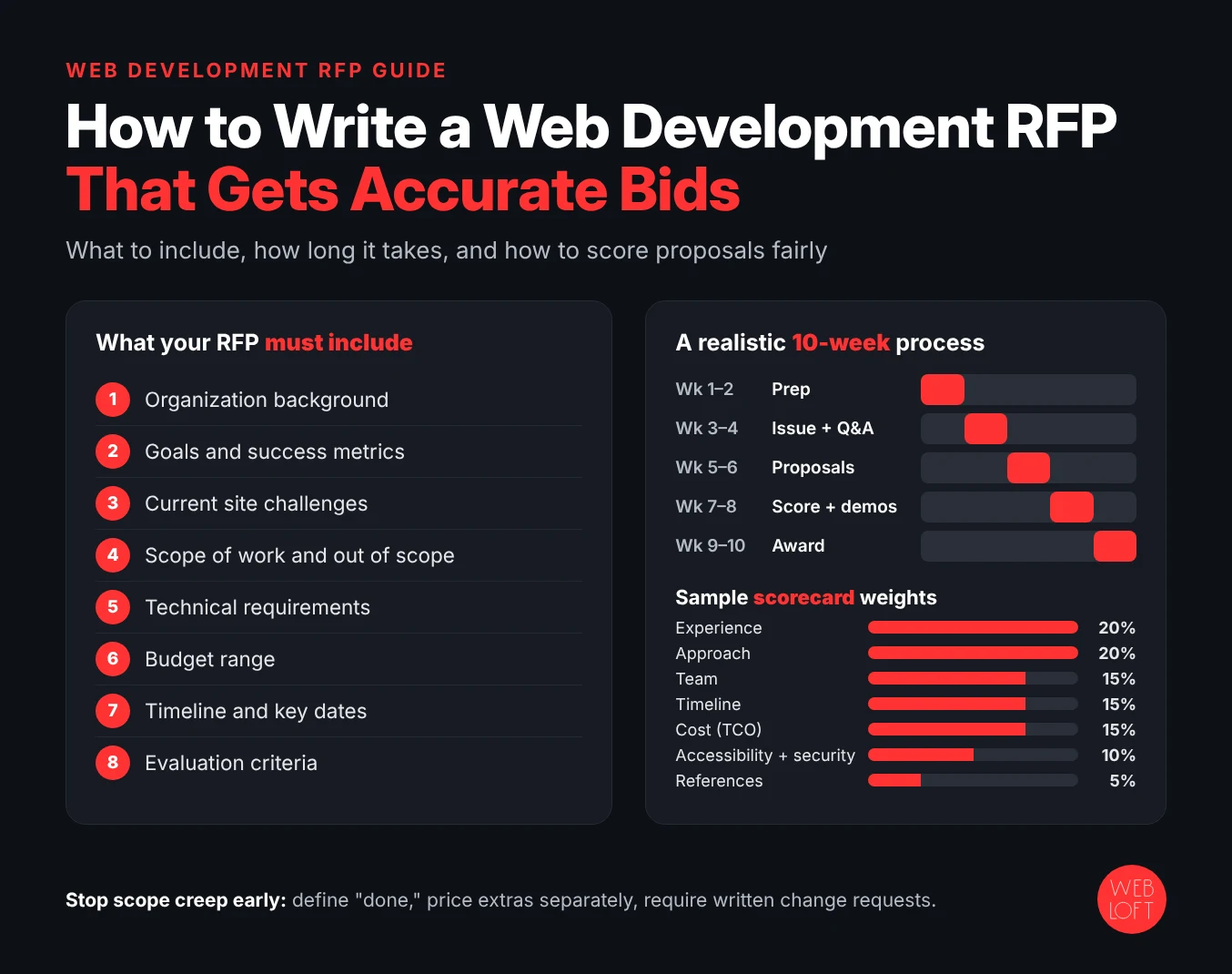
- Build a weighted scorecard before proposals arrive, covering experience, approach, team, timeline and cost.
- Run vendor Q&A in writing with one deadline, and share every answer with every vendor.
Table of Contents
- Why a Clear RFP Matters for Web Development
- Define Your Project Overview and Business Goals
- Outline Scope of Work and Technical Requirements
- Prevent Scope Creep Before the Project Starts
- Share a Budget Range
- Use a Website RFP Template to Stay Organized
- A Web Development RFP Example
- Ask the Right Vendor Questions
- Set a Website RFP Timeline and Vendor Selection Process
- Evaluate Proposals and Choose the Right Vendor
- Frequently Asked Questions
Why a Clear RFP Matters for Web Development
A request for proposal (RFP) is your roadmap for getting the website you actually need. Skip it, and vendors pitch their standard approach. You end up comparing five prices for five different projects, and the site you get may not match what you had in mind.
Not every project needs a formal RFP. If you already have one agency in mind, a short project brief is usually enough to get an accurate custom web development quote. An RFP makes sense when your organization requires competitive bids, when you plan to compare three or more vendors, or when several stakeholders need to agree on requirements before work starts.
At Web Loft Designs, we read RFPs from the vendor side of the table. The ones that lead to successful projects share the same traits, and this guide walks through them.
Define Your Project Overview and Business Goals
Start here: why does your website need to change? Not “because it’s old,” but what’s broken and what it’s costing you in customers.
Start With Your Organization Background
Write 2 to 3 sentences on what you do, who you serve and why your website matters to your bottom line. Skip the company history.
Example: “We’re a healthcare staffing firm placing nurses and therapists with hospitals and clinics. Our website is our main lead generator.”
That tells a vendor your industry, your audience and what the site needs to do.
Articulate Project Goals and Success Metrics
Most RFPs fall short here. They say “increase leads” without defining it. Instead of “improve performance,” write “reduce page load time to under 2 seconds.” Metrics give vendors a target and give you a way to measure success.
Examples of measurable goals:
- Increase qualified lead submissions by 15% within 6 months
- Reduce page load time from 4 seconds to under 2 seconds
- Improve mobile conversion rate from 1.2% to 2.5%
Pick 3 to 5 goals and list them in priority order. More than that and nothing gets priority. When vendors have to make trade-offs, the order tells them which way to lean.
Outline Scope of Work and Technical Requirements
This section tells vendors what you want built. Be detailed but realistic.
Current Website Challenges and Constraints
Describe what’s not working and be honest about your limitations.
Common challenges:
- An outdated content management system that’s hard to update
- A site that doesn’t work well on mobile devices
- Slow page load times that hurt search rankings
Also list constraints: budget limits, timeline pressure and systems you must integrate with. Point out what must be kept, such as pages that rank well in search, existing integrations or content that took years to build.
Functional and Design Requirements
List what the site needs to do, not how it looks.
Functional requirements:
- User account login and profile management
- Product or service search and filtering
- Shopping cart and checkout process
Design requirements:
- Match current brand guidelines
- Mobile-first responsive design
- Accessibility compliance with the WCAG 2.1 AA standard
Be clear about what’s flexible. If your brand colors are non-negotiable, say so. If you’re open to a full redesign, say that too. State whether you need WordPress or a custom platform, or ask vendors to recommend one and explain why.
Content, SEO and Migration
Say who will write the copy and supply photography, and how much existing content needs to move to the new site. If your current site gets search traffic, require a redirect plan for old URLs, carry-over of page titles and meta descriptions, and tracking setup. A redesign that loses existing rankings can cost more in lost leads than the site itself.
Prevent Scope Creep Before the Project Starts
Scope creep happens when requirements grow after the contract is signed. It is the most common reason web projects run over budget and past deadline. Your RFP is the best place to stop it early.
- Define “done” for each deliverable. “Product pages” is open-ended. “One product template with a specs table, PDF downloads and a quote request form, applied to 40 products” is not.
- Separate must-haves from nice-to-haves. Ask vendors to price optional items separately, so you can add them later without reopening the whole contract.
- State what is out of scope. This keeps vendors from padding their bids to cover guesses.
- Get stakeholder sign-off before the RFP goes out. Late input from a department that wasn’t consulted is a classic source of mid-project changes.
- Set the number of revision rounds. Agree on how many rounds of design and content revisions are included.
- Agree on a change request process. Every new request gets a written estimate of cost and time impact before work begins.
Share a Budget Range
Many buyers leave the budget out, hoping for a lower number. In practice this makes bids harder to compare, because each vendor scopes the project to a different price point. A range lets vendors propose the best solution for what you can actually spend. Our guide to custom web development costs can help you set a realistic one.
Use a Website RFP Template to Stay Organized
A template keeps you from forgetting sections and makes vendor responses easier to compare.
| Section | What to Include | Why It Matters |
|---|---|---|
| Organization Background | Company description, industry, audience | Vendors understand your business context |
| Project Overview | Current situation and why change is needed | Vendors see the real problem you’re solving |
| Goals and Success Metrics | Specific, measurable outcomes | You can evaluate whether the project worked |
| Scope of Work | What gets built, what doesn’t, how changes are handled | Prevents scope creep and surprise costs |
| Technical Requirements | Platform, integrations, performance targets | Vendors know what’s required upfront |
| Timeline | Key dates and milestones | Everyone agrees on deadlines |
| Budget | Available funding or range | Vendors can propose realistic solutions |
| Vendor Qualifications | Experience, team size, relevant work | You hear from qualified vendors only |
| Evaluation Criteria | How you’ll score proposals | Fair comparison across all vendors |
A good template saves weeks of back-and-forth and signals that you’re serious.
A Web Development RFP Example
Here’s what a strong project overview looks like:
“We operate three physical therapy clinics. Our current website is a basic brochure site built in 2018. Patients can’t book appointments online, and staff spend 10+ hours per week on scheduling calls. Our search rankings have dropped 40% in two years. We need a redesigned site with an online booking system integrated with our existing practice management software. The new site must load fast, work well on mobile and make it obvious how to book an appointment.”
A vendor knows exactly what they’re solving. Compare it to “We need a new website that’s modern and user-friendly with better SEO,” which tells them nothing. The first example names the problem, the impact and the solution.
Ask the Right Vendor Questions
Your RFP should ask for specific information. Don’t just ask “What’s your experience?” Ask about the experience that matters to your project.
Questions to include:
- How will you approach information architecture and user flow design?
- What’s your process for gathering requirements and validating them with stakeholders?
- How do you handle content migration from the current site?
- How do you test page speed, and will the site meet Google’s Core Web Vitals thresholds?
- How do you handle change requests once the project is underway?
Specific questions get real answers about how vendors work. Generic questions get generic answers.
Set a Website RFP Timeline and Vendor Selection Process
Your timeline keeps the project from dragging on and tells vendors when to expect a decision. A timeline without owners is just a wish list, so build both at once.
Assign Roles Before You Send Anything
Name one RFP owner, the single point of contact who keeps the schedule moving. Then name a decision group of three to five people: leadership, marketing or sales, IT or operations, and one person who uses the site daily. Write down who has final sign-off. If the answer is “the committee,” every approval will stall.
A Realistic Timeline
A typical schedule for a mid-sized website project:
| Phase | Timing | What Happens |
|---|---|---|
| Internal prep | Weeks 1-2 | Finalize requirements, confirm budget range, name the RFP owner and reviewers |
| RFP issued | Week 3 | Send to shortlisted vendors and set a questions deadline |
| Vendor Q&A | Week 4 | Collect written questions and publish answers to all vendors at once |
| Proposal window | Weeks 5-6 | Vendors write and submit; give at least two to three weeks |
| Review and scoring | Week 7 | Independent scoring, then a reconciliation meeting |
| Shortlist presentations | Week 8 | Top two or three vendors demo and answer questions |
| References and negotiation | Week 9 | Reference calls, contract terms, final scope confirmation |
| Decision and kickoff | Week 10 | Award, notify all vendors, schedule the project start |
Build in buffer, especially around internal reviews and content creation. Those are the steps that most often push launches back.
Run the Q&A Fairly
Every vendor should get the same information. Collect questions in writing by a stated deadline, answer them in one document and send it to every vendor, including those who didn’t ask. This prevents an inside track.
Tell Vendors How the Process Works
State upfront whether you’ll interview all vendors or only the top three, whether you’ll ask for revisions and when you’ll notify everyone. A clear process filters out vendors who can’t commit to your schedule.
Pro Tip: Publish the decision date in the RFP and hold it. A missed decision date signals to vendors that the project may stall after the award too.
Evaluate Proposals and Choose the Right Vendor
Scoring fairly means the same criteria, weights and reviewers for every vendor. Score one proposal on a Tuesday with two people and another on a Friday with five, and you’re comparing moods, not vendors.
Build the Scorecard Before Proposals Arrive
Write your rubric while the RFP is still going out the door, so the criteria match the questions you asked.
A workable weighted scorecard:
| Criterion | Weight | What You’re Actually Judging |
|---|---|---|
| Relevant experience | 20% | Two or three projects in your industry or a close analog, with references you can call |
| Proposed approach and architecture | 20% | Whether the plan addresses your stated challenges, not a generic pitch deck |
| Team and availability | 15% | Named people, their roles, and whether they’re staff or subcontractors |
| Timeline and milestones | 15% | Realistic phasing, dependencies called out, a launch date you can live with |
| Cost and total cost of ownership | 15% | Build cost plus hosting, licenses, maintenance, training and future work |
| Accessibility, security and performance plan | 10% | Specific testing methods, not just a promise to “follow best practices” |
| References and case studies | 5% | Whether past clients describe the same experience the vendor promises |
A vendor who nails experience but hand-waves the technical plan will land mid-pack, which is usually the right outcome.
Run a Consistent Review Workflow
Have two reviewers read every proposal independently, score them separately, then reconcile in one meeting. Discuss and re-score any criterion where they differ by more than one point. This takes an afternoon and removes most gut-feeling bias.
Keep a written note for every score. When a vendor asks why they weren’t selected, you want a factual answer.
Compare Proposals That Don’t Look Alike
Vendors rarely format proposals the same way. One sends 40 pages, another a 6-page letter. Normalize before you score:
- Put every proposal into the same section order as your RFP.
- Flag any requirement a vendor skipped or answered vaguely. A missing answer is a data point, not a neutral.
- Separate one-time build cost from recurring cost so you’re comparing like with like.
Check References Like You Mean It
A reference call that asks “were you happy?” gets a polite yes. Ask instead:
- What did the vendor do well, and what did they struggle with?
- How did they handle a change request or a missed deadline?
- Who did the actual work, and was it the person in the sales pitch?
- Would you hire them again?
Two or three calls tell you more than any case study page.
Watch for the Warning Signs
A quality custom website takes real time and real money. Be careful with proposals that show:
- A price far below every other bid, with no explanation of what’s left out
- A launch date that skips discovery, content or testing
- No named team members, or a team that’s mostly subcontracted
- Copy-paste answers that never mention your goals or challenges
- No questions back to you during the Q&A period
The strongest signal in the other direction is a vendor who pushes back on vague requirements, asks follow-up questions and tells you which parts of your RFP are unrealistic.
Before you sign, review the vendor’s case studies and work samples for projects like yours.
Key Takeaway: Score every proposal on the same weighted rubric, reconcile reviewer disagreements in writing, and treat a vague or missing answer as a low score, not a benefit of the doubt.
If you’re planning a new site or a rebuild, Web Loft Designs can review your requirements and recommend the right approach for your website design and development project. Get a Free Quote to get started.
Frequently Asked Questions
What should a web development request for proposal include?
A complete web development RFP includes your organization background, project goals and success metrics, current website challenges, scope of work, functional and technical requirements, budget range, timeline, vendor qualifications and evaluation criteria. Add specifics on content migration, integrations, hosting, security and accessibility requirements, and post-launch support. The more detail you give upfront, the more accurate and comparable the proposals will be.
How long should a website RFP be?
Most effective RFPs run 6 to 10 pages. That’s enough to define scope and requirements, and short enough that vendors read every section. Open with a one-page executive summary so decision-makers can grasp the project quickly.
Should I include a budget in a website RFP?
Yes. A budget range helps vendors recommend a solution you can afford and makes their bids easier to compare.
How do you evaluate web development proposals?
Create a scoring rubric before proposals arrive so the evaluation is fair and consistent. Review each proposal against your original requirements, not what sounds impressive. Check references, review case studies relevant to your industry and ask clarifying questions about anything vague. Schedule demos with the top candidates before you decide.
What questions should you ask web development vendors?
Ask how they handle discovery and requirements gathering, what their development and testing process looks like, how they manage change requests and scope creep, and what support they provide after launch. Ask about their team, communication cadence and experience with similar projects, and what they would recommend differently from your RFP.
How do I avoid scope creep in web development?
Define each deliverable in detail, state what is out of scope, separate must-haves from optional items, limit revision rounds and require a written change request with cost and time impact for anything new.
What is the difference between an RFP and a project brief?
A project brief describes your project so one agency can quote it. An RFP adds proposal requirements, evaluation criteria and a timeline so several agencies can compete on the same terms.