


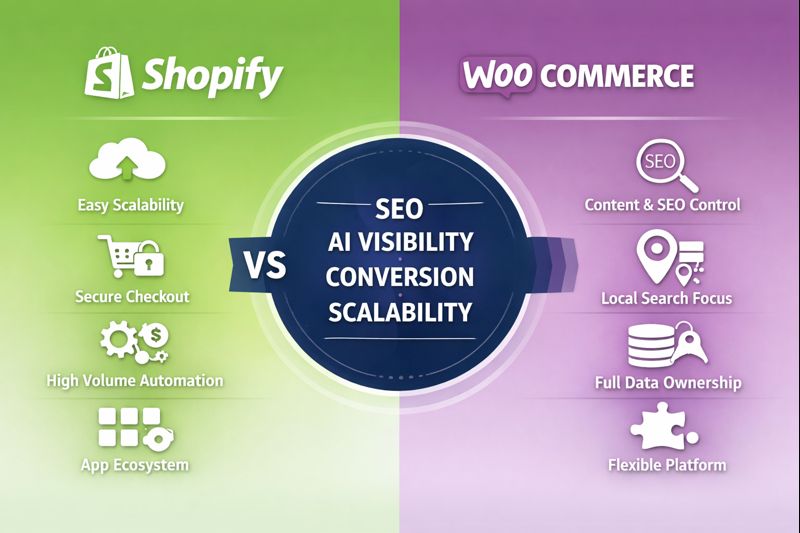
When businesses compare Shopify and WooCommerce, the conversation usually starts with features and pricing. But for brands that care about growth, visibility, and long-term performance, the real question is different:
Which platform gives us the strongest foundation for search, AI discovery, and conversion at scale?
At Web Loft, we don’t approach this as a templates vs plugins debate. We build fully custom eCommerce experiences on both platforms, and the right choice depends on how your business plans to compete: organically, locally, nationally, and increasingly inside AI-driven search environments.
Let’s look at the difference through the lens that actually matters: SEO, structured data, AI visibility, and business scalability.
The SEO reality: both platforms can rank; architecture matters more than platform
From a pure SEO standpoint, neither Shopify nor WooCommerce has a monopoly on rankings. Google and AI systems do not “prefer” one CMS over another. They evaluate:
- Site architecture
- Content depth and clarity
- Structured data (schema)
- Page speed and Core Web Vitals
- Authority signals (links, brand, citations)
- Entity consistency (locations, products, services)
When WooCommerce is paired with proper one-time technical SEO and on-page optimization – exactly what we implement for our clients – it can match Shopify’s structured data output, crawlability, and indexing efficiency.
In other words:
A properly optimized WooCommerce site is just as AI-readable and Google-friendly as Shopify.
The difference is not the platform. The difference is whether SEO and structured data are built intentionally from day one or left to default settings.
AI search and structured commerce data
AI systems like Google’s AI Overviews, ChatGPT, Gemini, and Perplexity rely heavily on:
- Product schema
- FAQ schema
- Review schema
- LocalBusiness / Organization schema
- Clear entity relationships (brand, category, location, service, product)
Shopify provides strong out-of-the-box structured data for products and collections. This gives it a head start for businesses that do not invest in technical SEO.
At the same time, with proper schema, internal linking, and semantic structure in place, WooCommerce becomes just as strong. In fact, when SEO is configured correctly, it often offers more flexibility for advanced content setups like location pages, service hubs, comparison pages, and educational content tied directly to products.
So the correct statement is:
Shopify is schema-ready by default.
WooCommerce is schema-powerful when professionally optimized.
Custom Shopify vs template Shopify
One important distinction: when we talk about Shopify, we are not talking about off-the-shelf themes.
At Web Loft, we don’t use standard Shopify themes (we can for very small projects and start-ups though). We build custom Shopify sites with optimized collections, product structure, URLs, content, and structured data designed for SEO, AI visibility, and conversions.
This removes the typical limitations associated with “Shopify templates” and places Shopify in the same strategic category as custom WordPress builds—just with a different infrastructure layer.
When Shopify is the better strategic choice
Shopify is often the right platform when you need to scale quickly without managing servers, handle high transaction volumes, rely on built-in secure checkout and payments, run a product-heavy catalog, and take advantage of a mature app ecosystem with strong built-in commerce and structured data support.
It shines for DTC brands, national eCommerce, and businesses where operational efficiency and conversion flow are as important as organic visibility.
When WooCommerce is the better strategic choice
For brands where organic search, AI discovery, and content authority are the main acquisition channels, WooCommerce with professional technical SEO can become an exceptionally powerful platform.
Do you need a “custom build”?
Not in the sense of building an eCommerce system from scratch.
What you need is:
- Custom architecture
- Custom SEO structure
- Custom entity modeling
- Custom conversion flows
- Custom AI-readable content structure
This can be achieved on both Shopify and WooCommerce without abandoning mature platforms. The “custom” part is not the codebase—it’s the strategy and information architecture.
The strategic conclusion
The platform does not determine success.
The implementation does.
- Shopify gives you a strong, commerce-optimized, AI-ready foundation out of the box.
- WooCommerce gives you unmatched flexibility for content-driven SEO and AI authority when paired with proper technical and on-page optimization.
- Both can rank.
- Both can be cited by AI.
- Both can scale.
The real differentiator is whether your site is built as:
A template store
or
A search-engine-and-AI-optimized growth asset.
That is where Web Loft’s approach comes in: platform-agnostic, SEO-first, AI-ready, and built to support not just traffic, but qualified demand, brand authority, and long-term visibility in both traditional search and the emerging AI search layer.